We brought the unregulated fantasy team economy into Dream11.
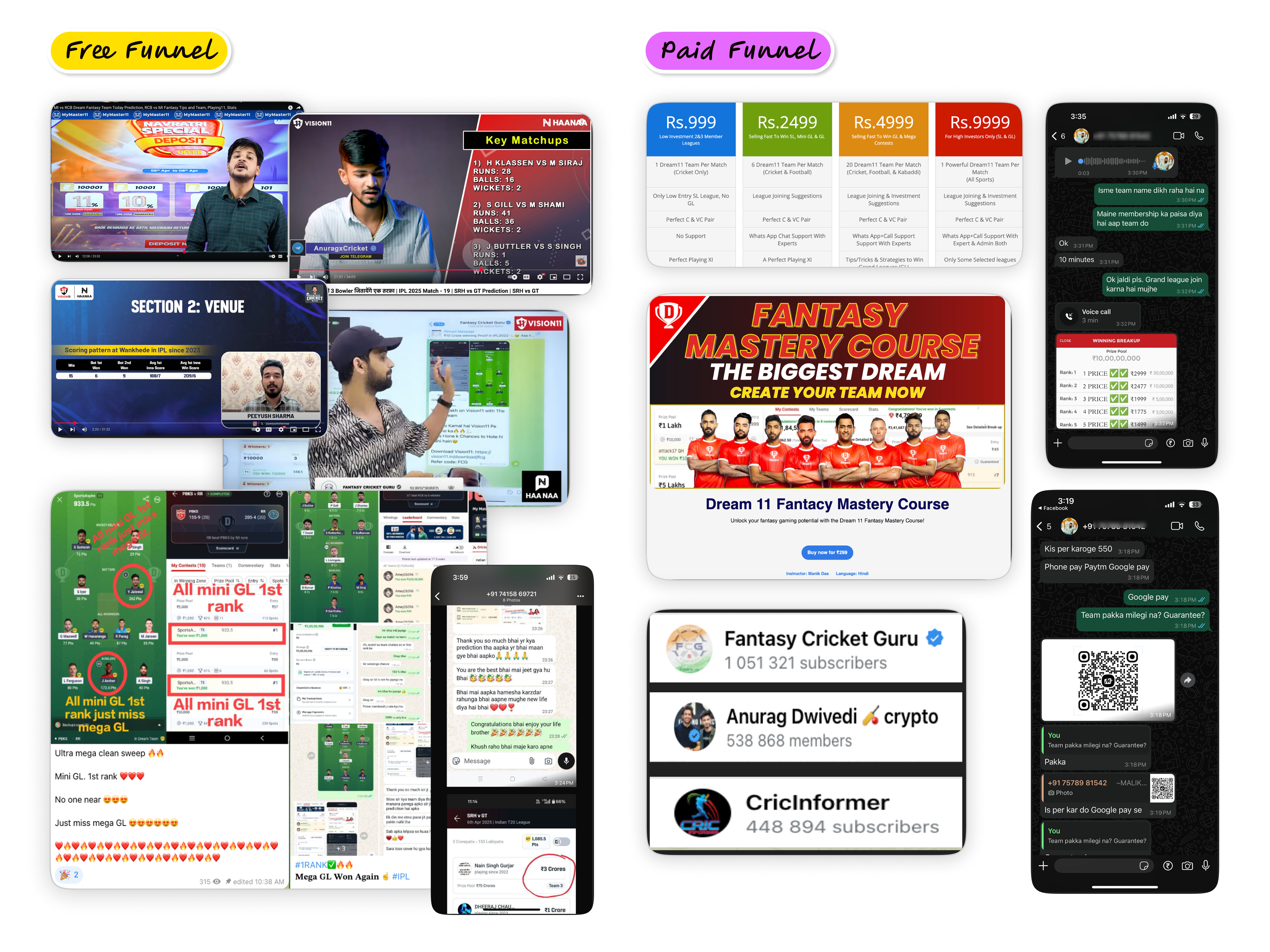
For years this ran on Telegram, WhatsApp and YouTube - unregulated and sometimes fraudulent. We brought the whole ecosystem inside, and turned our most loyal players into creators who could monetize their skills.
The problem
All the match data lived in a dozen places, and turning it into a team before the deadline was hard. So people paid strangers to hand them a ready team. Some were frauds.
The solution
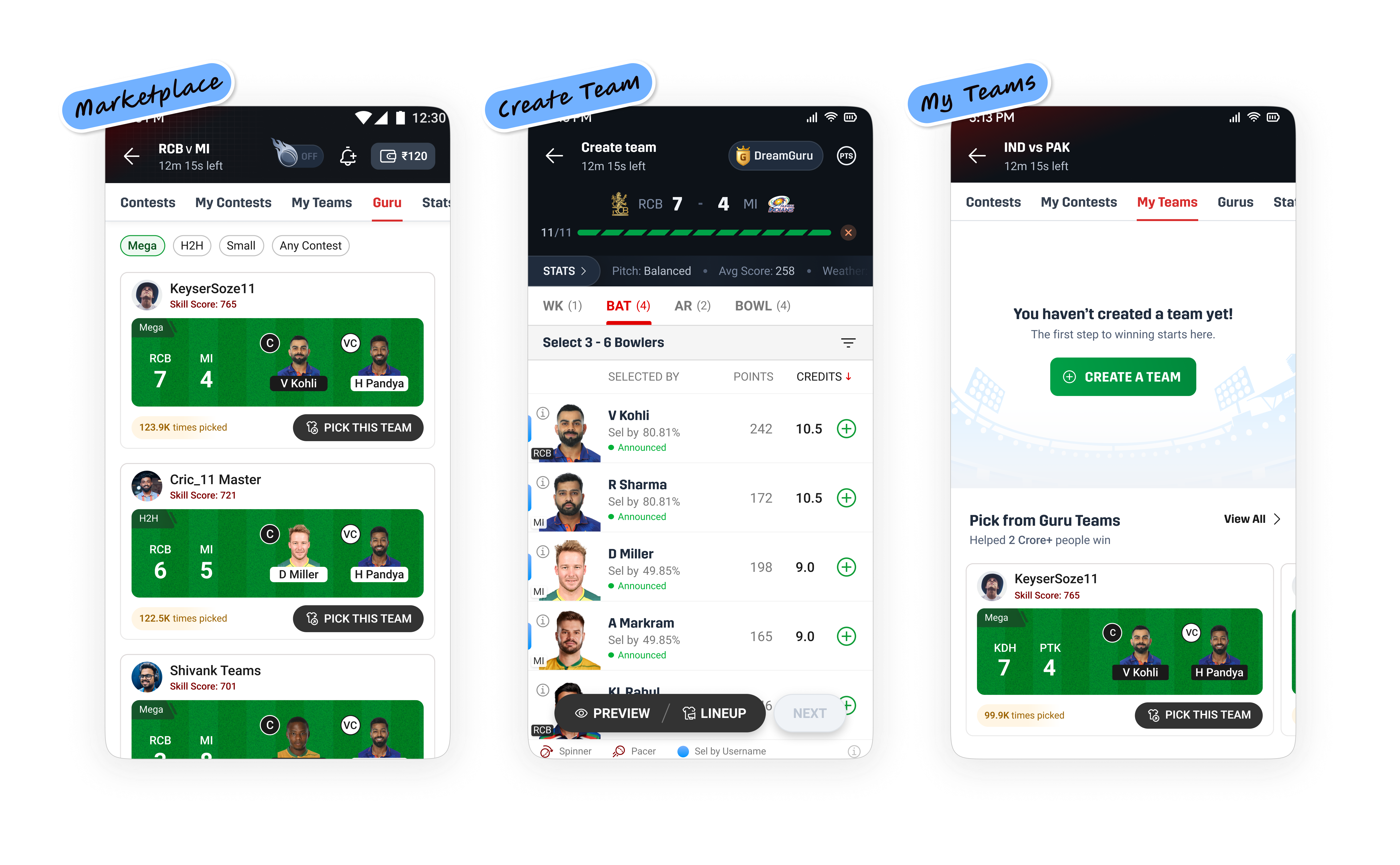
A marketplace of Gurus. Trusted players from our own platform share ready-made teams you save and tweak in seconds. Free for a year, then paid.
1→2.5
Teams per user
11%
Paid adoption
₹1cr
By 2 Gurus each
3m→5s
Team creation
01. The gap was outside the app.
Dream11 had match research, but no way to actually get a team. So when people froze while building one, they went outside for it, then came back to play. The hardest part - actually landing on a team - was the one part that happened off our app.
And a lot of it was a scam. The winning screenshots were often fake, and people paid for teams that never won. It worked because they were desperate: 15 minutes after lineups drop, money on the line, they'd pay almost anyone who promised a team that wins.
02. Why they left, and why it mattered.
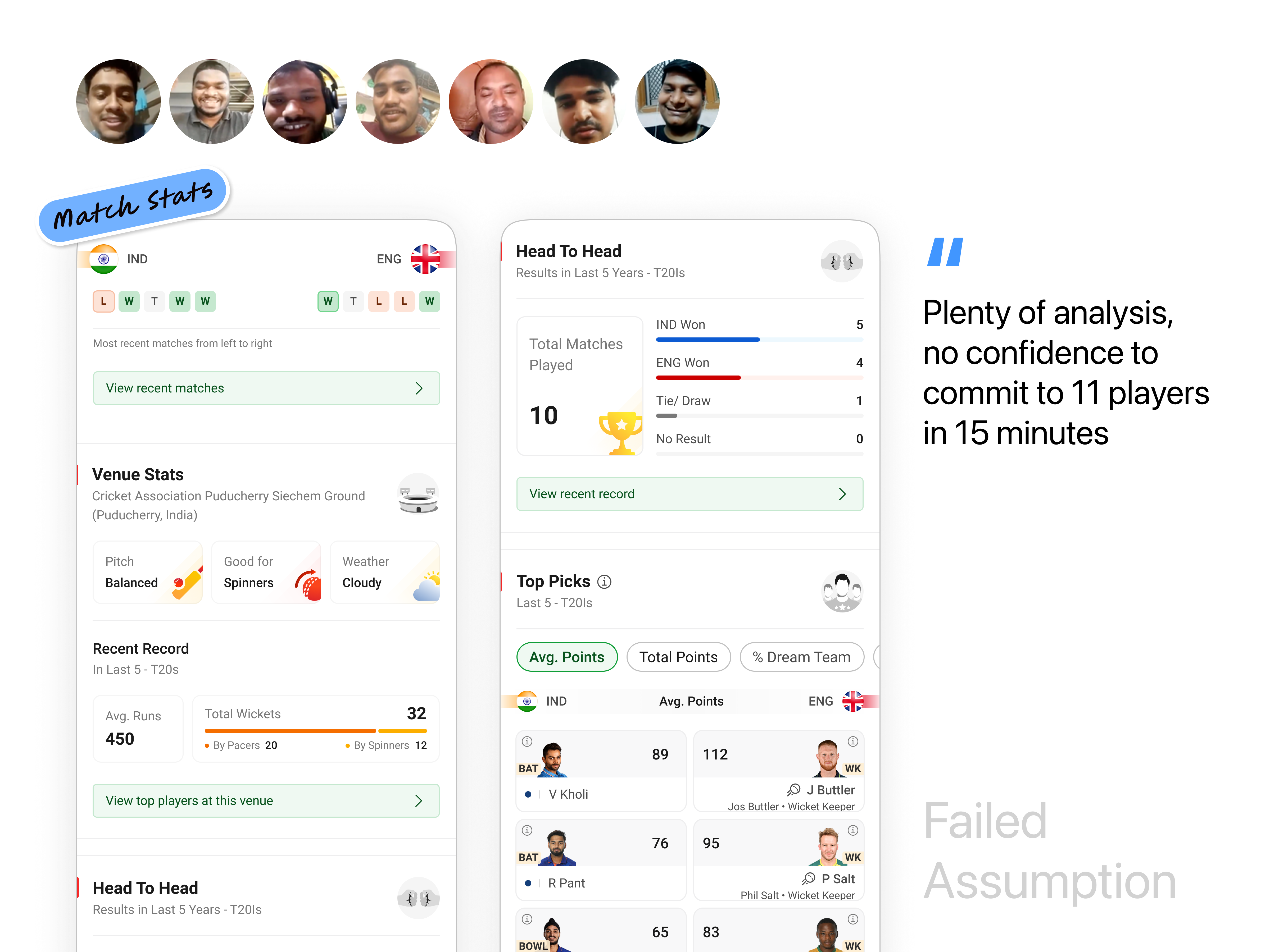
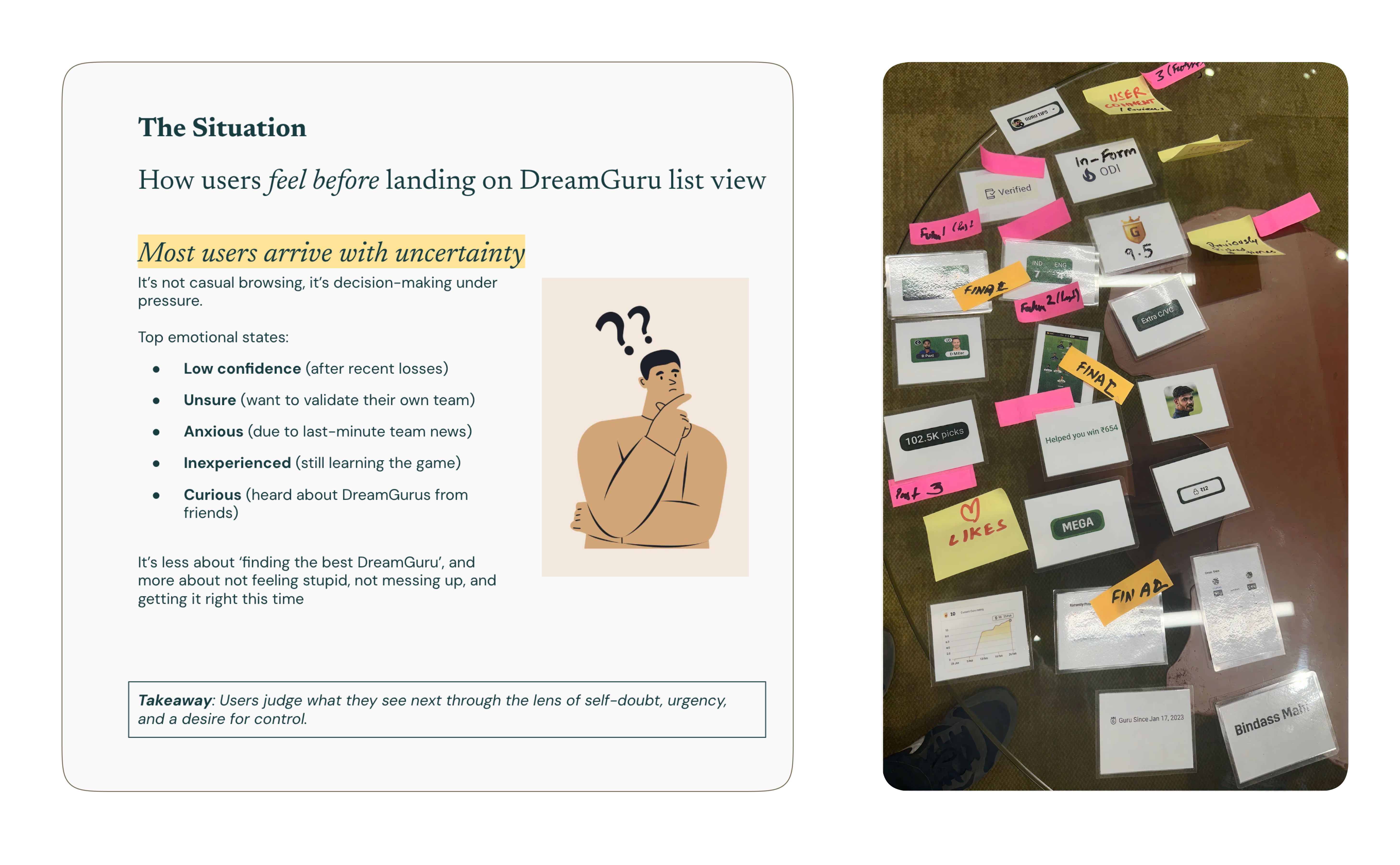
We talked to people who were buying teams outside, expecting to hear the app lacked information. It didn't. We had a Guide tab full of stats, and they'd seen it. The real problem was one step later:
They couldn't turn the data into a team in time. Plenty of analysis, no confidence to commit to 11 players in 15 minutes. So they paid someone outside who'd just hand them the team.
For 15 years, Dream11 trained the country that 7:30 means open the app and build a team. That's the moment we designed for, and the moment worth monetizing.
Low confidence didn't just cost the user. It capped the business:
01
User side.
No confidence in their picks, so they stopped at one team, or bought one outside.
02
Business side.
68% of players made exactly one team. The more teams someone makes, the more contests they join, and joining more is what grows the platform.
Confidence was the one lever that fixed both sides at once. Fix it, and people make teams they believe in, and make more of them. Exactly what the business needed.
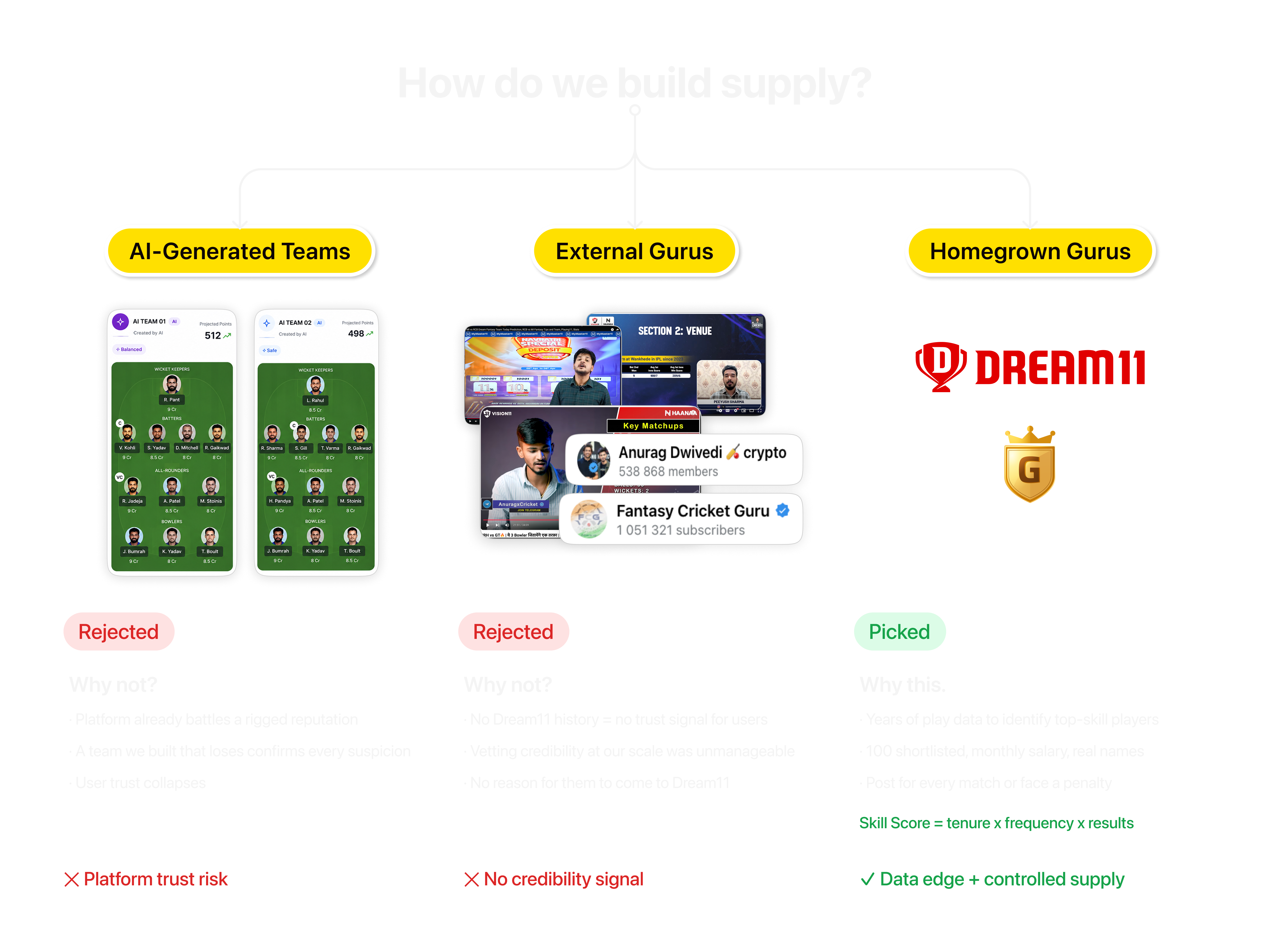
03. The supply bet: we grew our own experts.
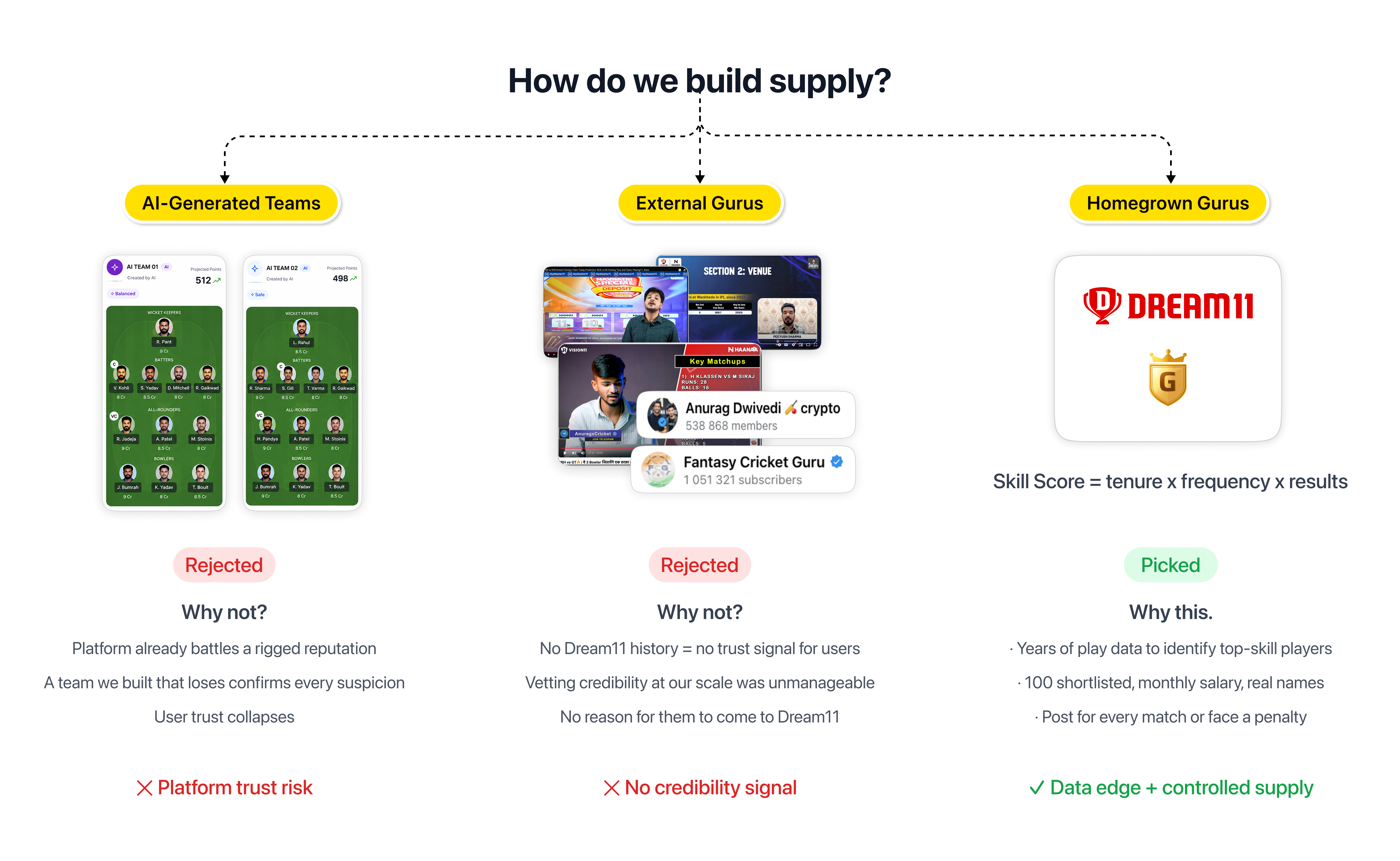
We had three ways to put teams in the marketplace. We picked the hardest one on purpose.
04. The marketplace.
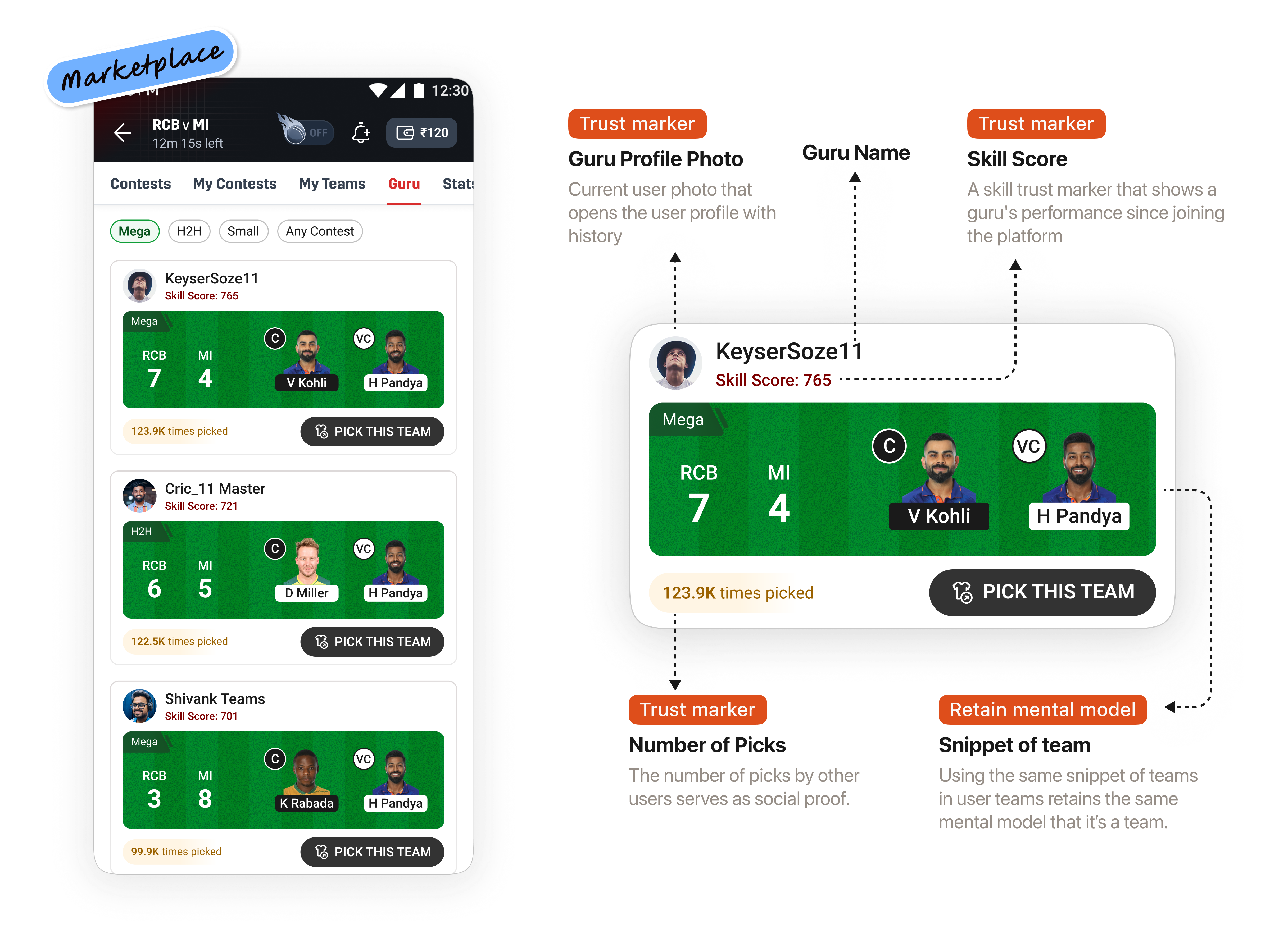
A marketplace needs a provider and a product. The provider was the Guru, the product was their team. One question drove the design: how do you trust a stranger enough to play their team, in 15 minutes?
Two decisions carried it. We shipped it lean, on purpose, to watch how people really chose a Guru.
01
Reuse what people knew.
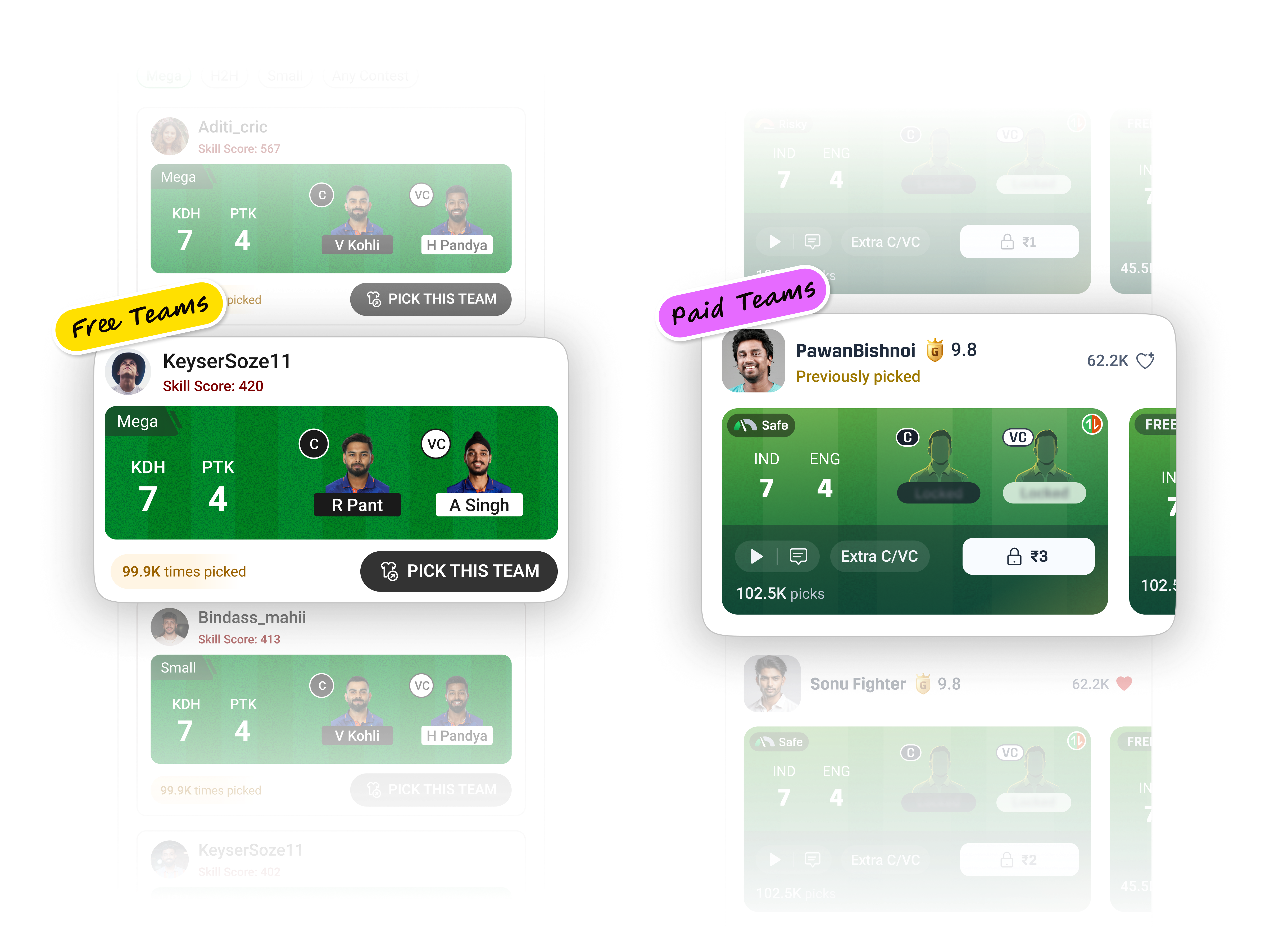
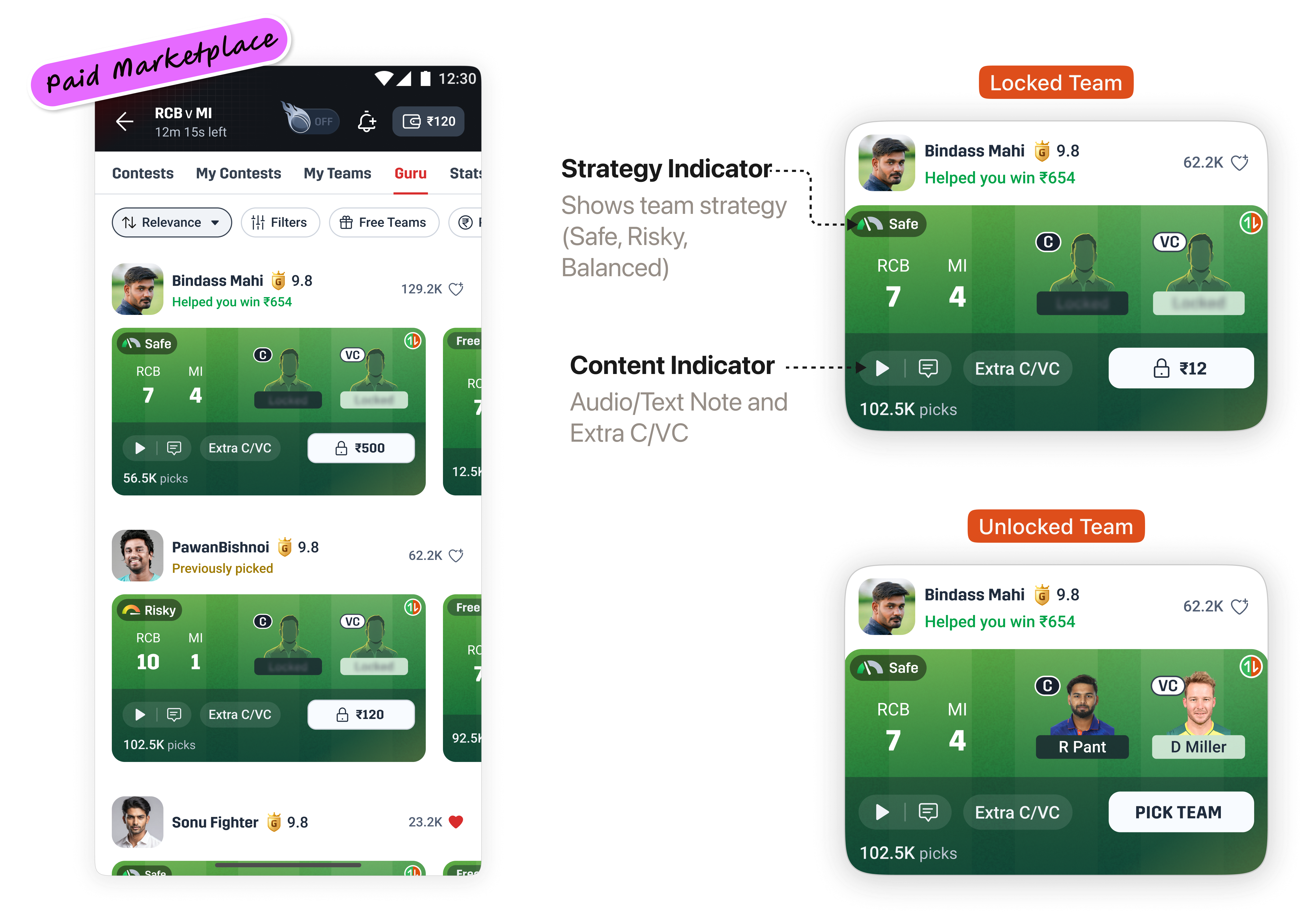
We showed each Guru's team as the same team card users saw when building their own. Nothing new to learn, and you could read the shape of the team at a glance.
02
Show real social proof.
The black market faked trust with screenshots of people winning. It worked because social proof works. So we built the honest version: a live count of how many users had actually picked each team, and this one couldn't be faked.
05. Help, without taking over.
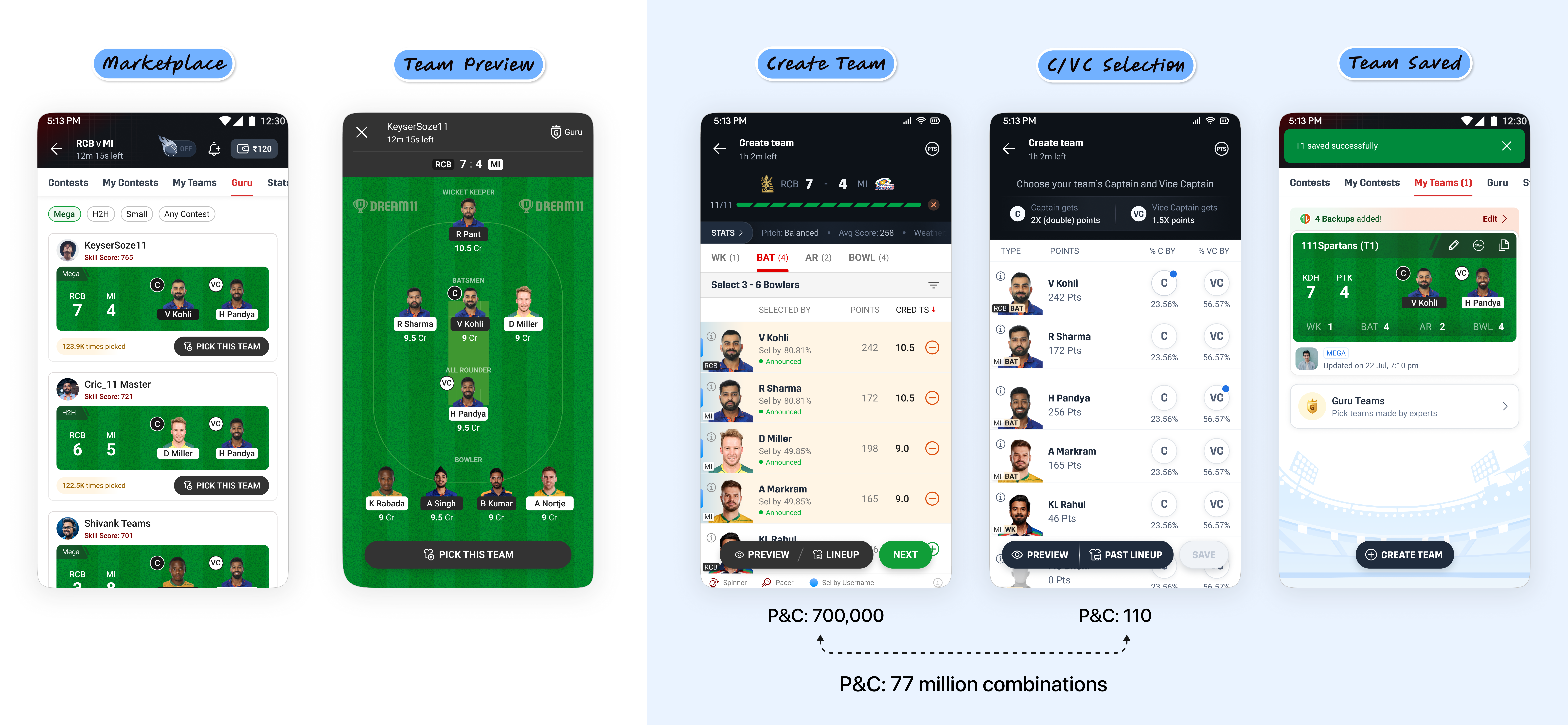
We didn't want a copy-paste machine. Copying a team kills the game and kills any sense that the team is yours. So we split the decision in two: the part that paralyzes people, and the part that's actually theirs.
01
The wall.
Picking 11 from 22 players is a huge space of possible teams. This is where people freeze and stop at one. The Guru clears it, you start with their 11.
02
The game.
Picking your captain and vice-captain is a much smaller call, but it's where matches are won: captain scores 2x, vice 1.5x. So we hand this one back to you.
We took away the huge choice that makes people freeze, and left them the small one that actually decides the match.
3m → 5s
Avg team creation time
From three minutes of second-guessing to a confident team, saved in seconds.
-80%
Creation time cut
The wall gone, the captain call kept - help without taking the game away.
06. Build the habit, then charge.
Leadership wanted to charge from day one. We pushed back, and it came down to one thing: nobody knew our Gurus yet.
Think about the experts outside the app. People paid them because they'd followed them for months. They'd built a name. Our Gurus had none of that. They were regular players we'd put on a stage, and no one knew if they were any good. Charging on day one meant asking people to pay a stranger, for something they'd never done inside the app before. So we did it in order. Free first, so the Gurus could build a following of their own. Money later, once people actually trusted them. That was always the plan.
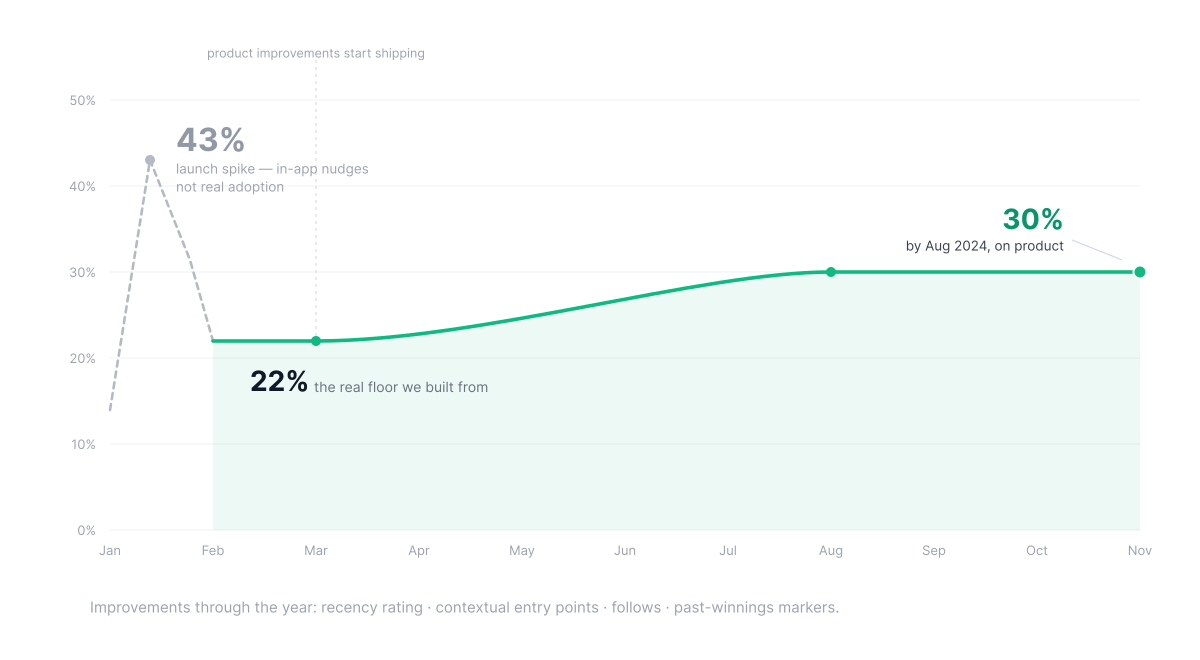
Then the launch numbers fooled us, and we knew they would. Week one spiked, but that was just the launch nudges, the bottom sheets and notifications you show inside the app. Three weeks later it settled to the real number. So we ignored the spike and spent the year growing from that floor, on the product itself, not promos.
We spent the year adding trust to the product, piece by piece:
Contextual entry points. We met people where they froze, on My Teams and inside Create Team, instead of making them find the marketplace. That alone lifted adoption by about a quarter.
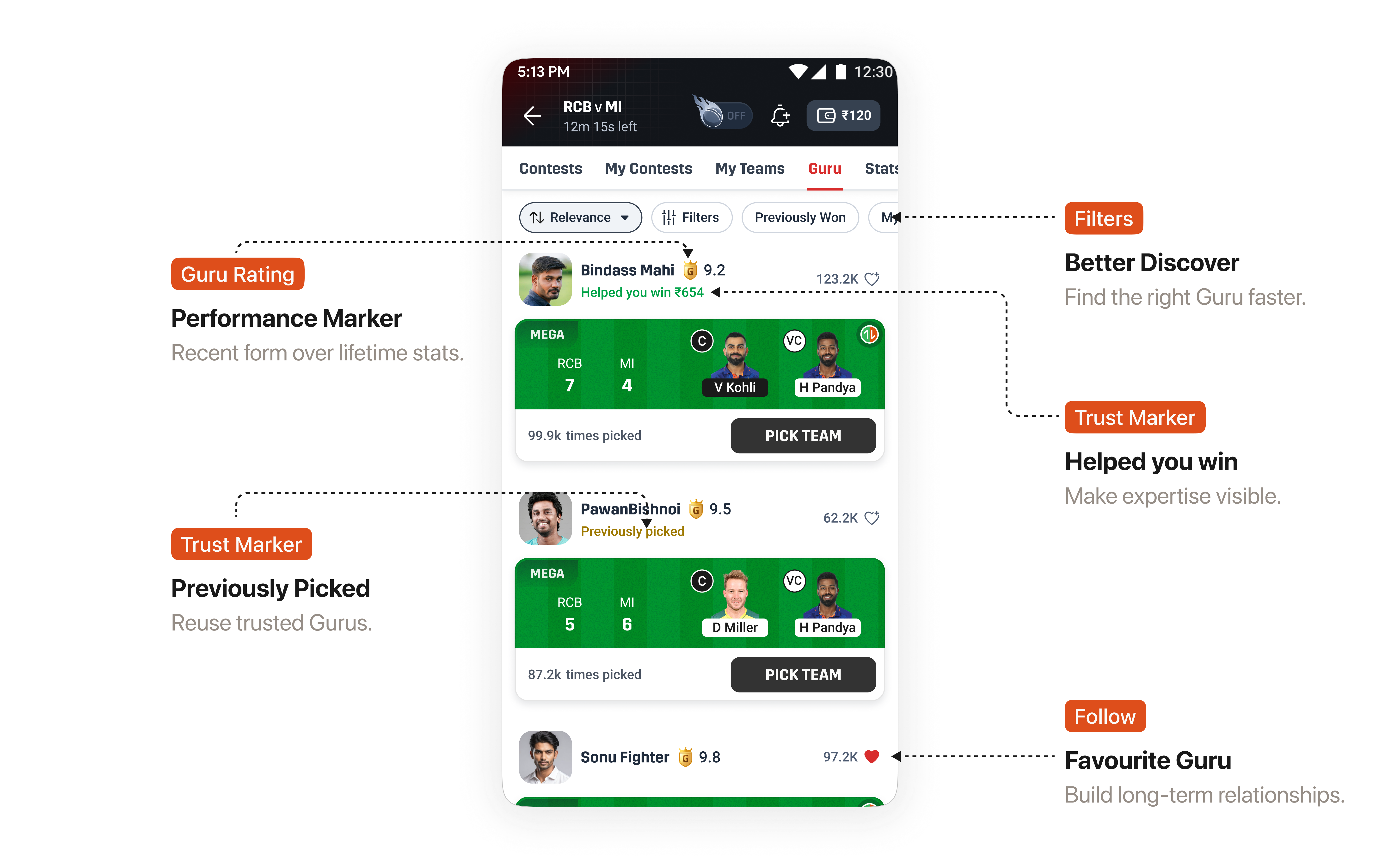
A recency-based rating. Gurus ranked on their last 5 teams, so current form counted more than old wins.
A "you've picked this before" marker. If a Guru had worked for you once, we made it easy to find them again.
Follows. Save a Guru you liked and come back to them next match.
Past winnings on the card. "You won ₹500 with this Guru," so the payoff was right there.
Each was small. Together they turned a one-off pick into a habit of returning to a Guru you trust, and that's what carried adoption from 22% to 30%.
07. Designing the paid version.
Before charging, we ran research to answer one question: who is worth paying for? It reshaped the paid marketplace around the signals people actually trusted.
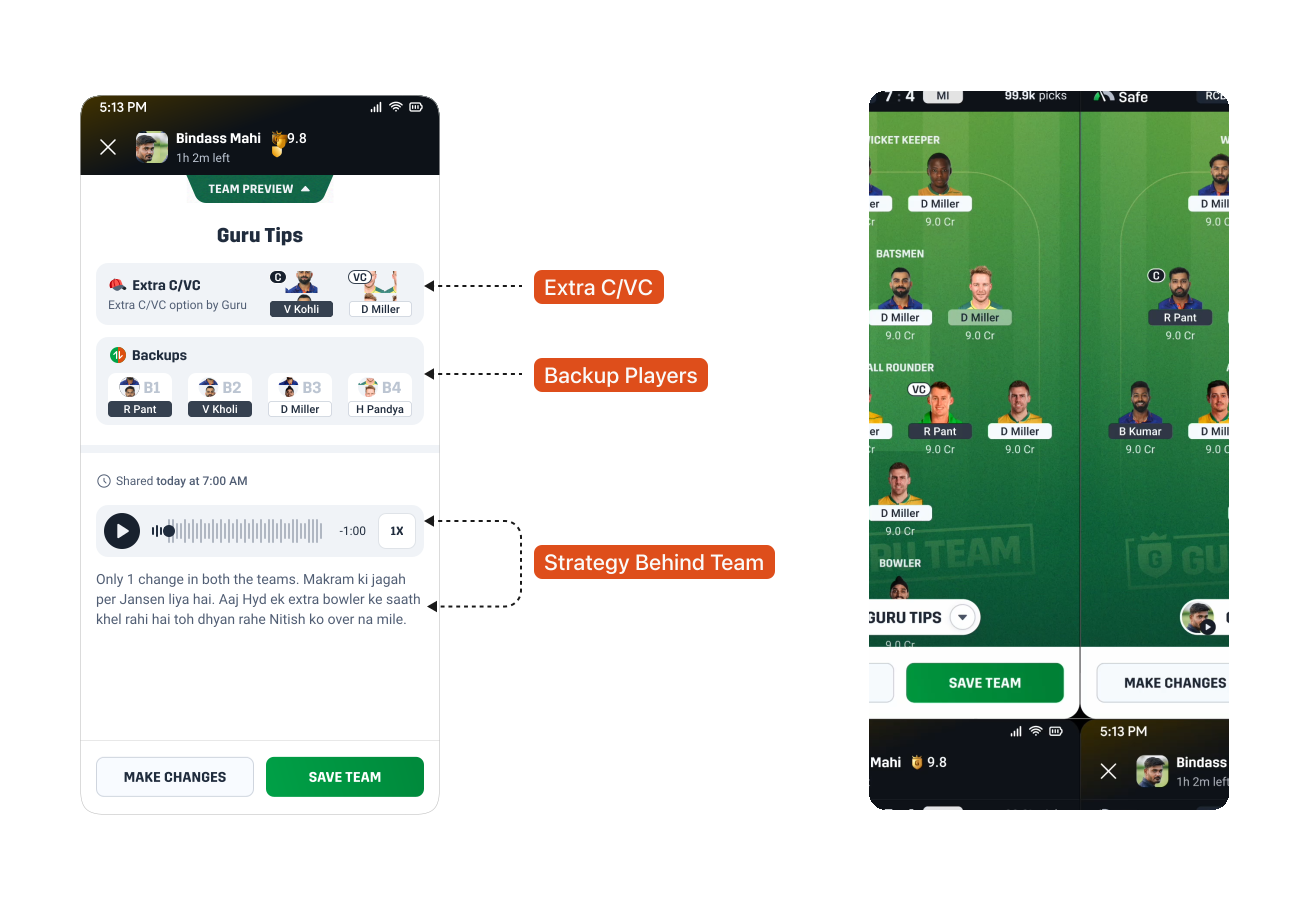
Legal wouldn't let us sell a bare team, we had to add real value. So we gave people the why the outside experts always shared, and turned a constraint into the reason a paid team was worth paying for.
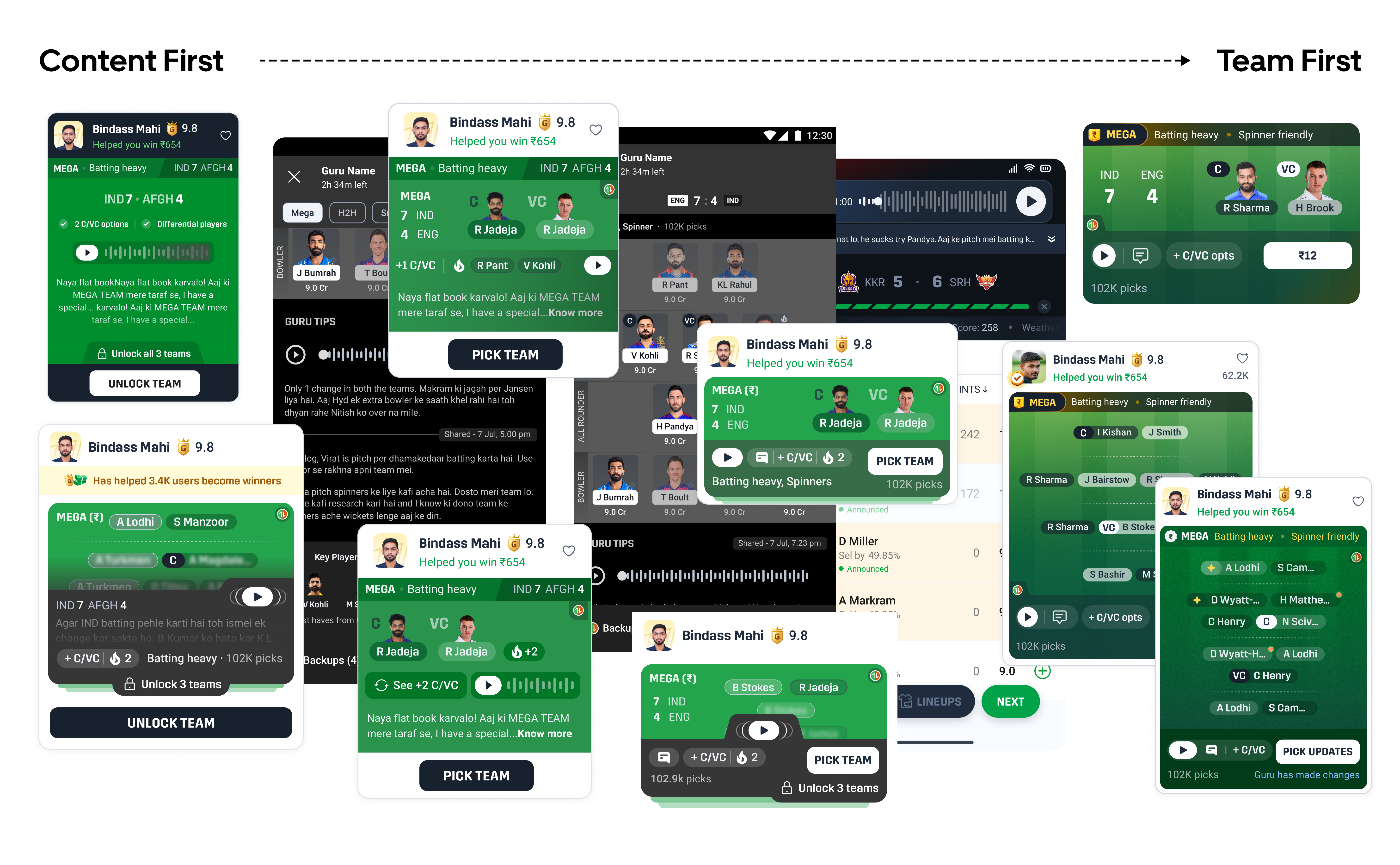
Then the fight. Leadership wanted the content to be the hero, analysis up top, the team locked behind it. I held team-first. People arrive with three minutes and they came for a team. They're already paying a Guru they trust to do the research, so the proof can sit one tap away, but the team is what they're here for. We shipped team-first, with the content easy to reach for anyone who wanted it.
08. Getting the price wrong, then right.
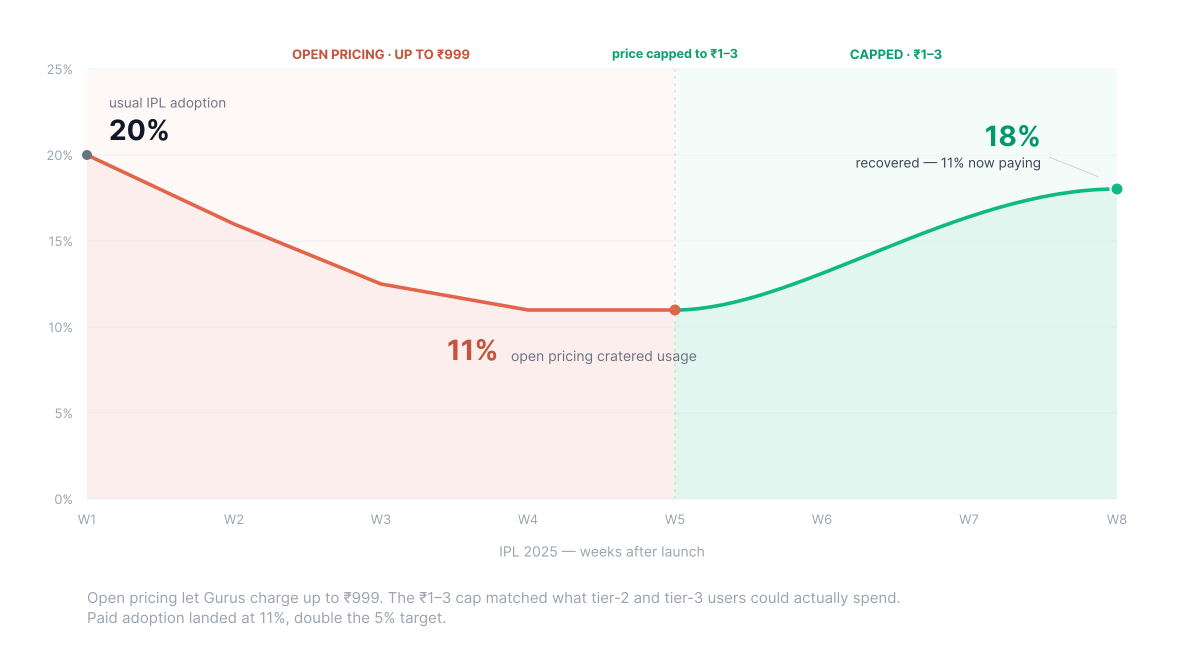
We launched open, on purpose. Gurus set their own price, capped high at ₹999, and we trusted the market to settle itself: price high, and the good creators would win, the rest would come down.
The bet was sound. What we got wrong was the timing. We'd launched right before IPL, our biggest window of the year, and three weeks in the market still hadn't corrected. Adoption kept sliding, nearly half our usual IPL level gone. We couldn't bleed through IPL waiting for it to fix itself.
So we capped prices at ₹1 to ₹3 to recover, and planned to reopen later. It worked. Paid adoption landed at 11%, double our 5% target.
09. What it moved.
1→2.5
Teams per match
Up from one team for 68% of players.
11%
Paid adoption
Against a 5% target - more than double.
22→30%
Free adoption
Across the year, on product not promos.
Two Gurus each generated ₹1cr in sales, with Dream11 taking a 20% cut of every paid team.
Most players made exactly one team. For the average to reach 2.5, the people stuck at one, the ones losing or paying strangers off-platform, are the ones who started making more.
10. Where it goes.
We didn't just replace the Telegram channel. We built what it should have been: an advice economy out in the open, accountable, and safe.
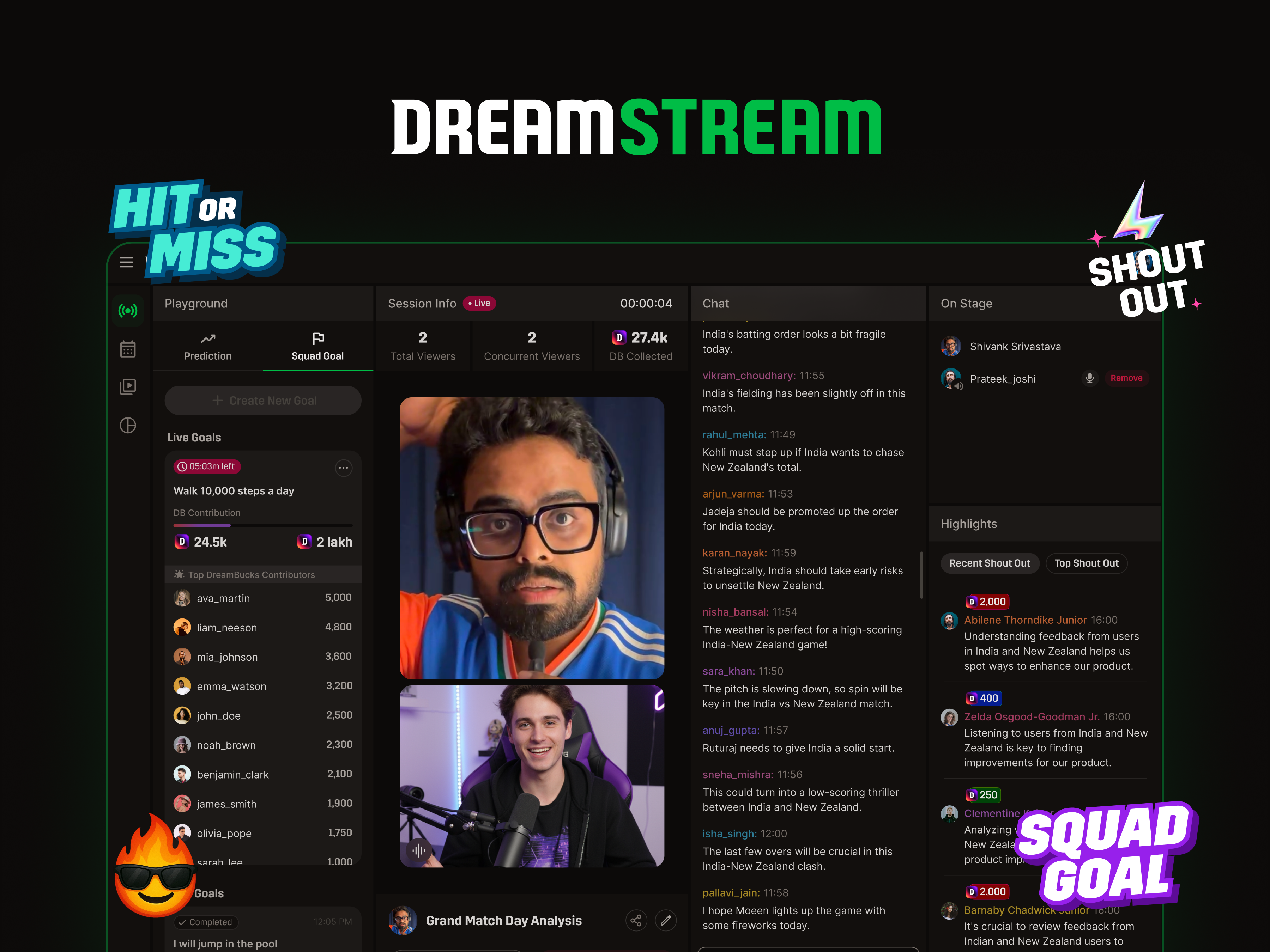
The direction from here is live. Gurus going on during the 7:30 window, walking through their team, taking questions from anxious players in real time. And at scale, 10,000 homegrown Gurus earning a real living on Dream11.
Three things I'd carry into the next one:
Lesson 01
Free earned the paid.
A year of free proof bought the right to charge.
Lesson 02
Trust beats novelty.
In a skeptical category, a real human with a record beats a smarter algorithm.
Lesson 03
Design the rules, or they design you.
In a marketplace, discovery, pricing, and refunds don't self-correct.